Jamaican clothing colors usually mean one of two separate things, and people mix them up constantly. Black, green and gold are the actual Jamaican flag colors, adopted at independence in 1962. Red, gold and green are the Rasta and reggae colors, tied to Ethiopia and a Pan-African flag Marcus Garvey designed decades earlier. Different flags, different history, easy to confuse on a t-shirt.
Black, Green and Gold: The Jamaican Flag Colors
The Jamaican flag was hoisted for the first time at midnight on August 5, 1962, as the British flag came down after more than 300 years of British rule. It was formally adopted the next day, August 6, now marked every year as Jamaica's Independence Day.
The design is a diagonal gold cross on a green and black field: gold cross, green triangles at top and bottom, black triangles on the two sides. It's the only national flag in the world with none of white, red or blue in it, which is part of why Jamaicans often just call it "The Cross," or simply "Black, Green and Gold."
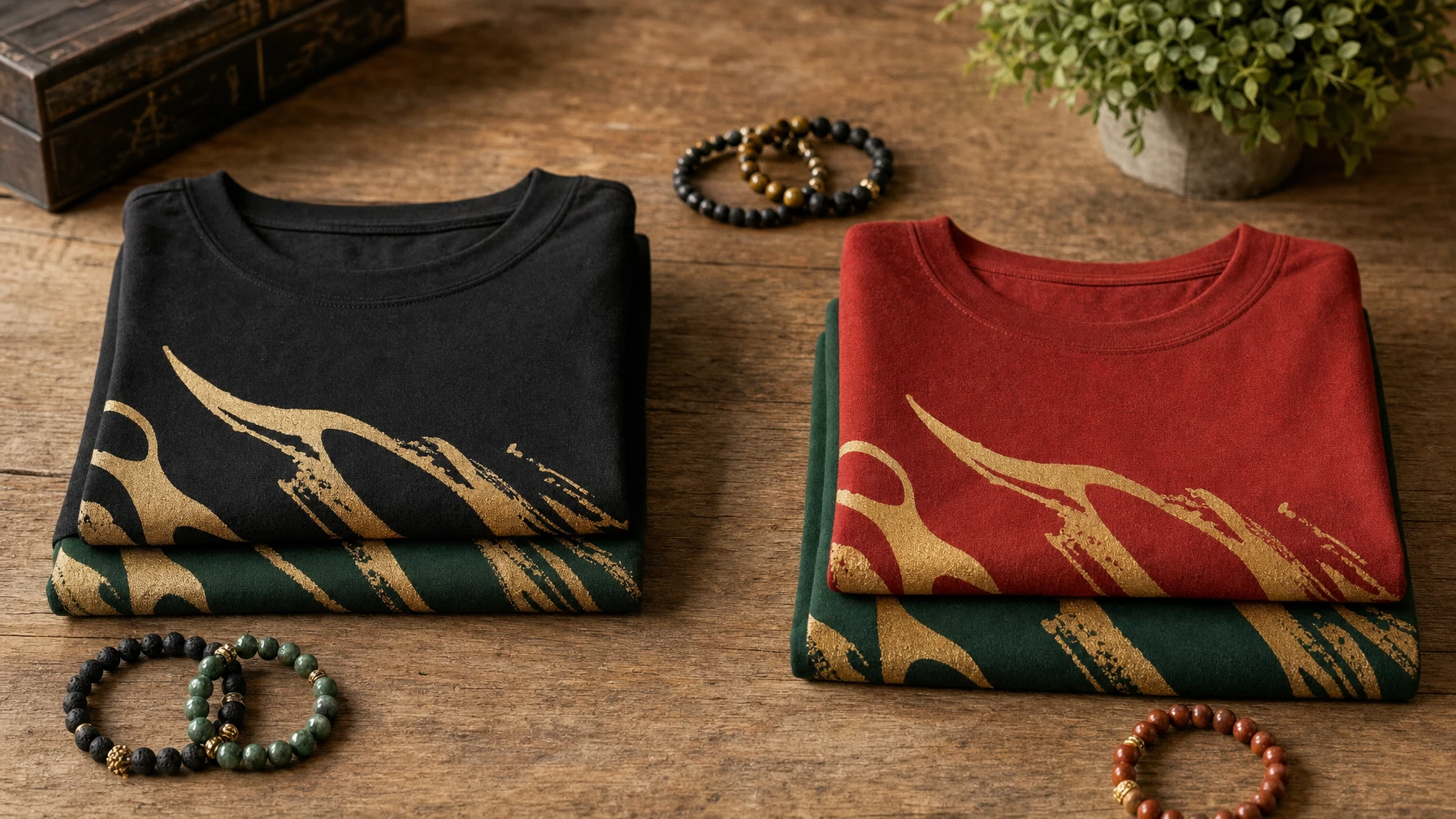
That's also why you'll find the same three colors worked into a black, green and gold clothing line far beyond Independence Day itself. Tees, hats, anything meant to say "Jamaica" at a glance tends to reach for this exact palette.
What each color actually stands for
The current official meaning, set by the government in 1996, is specific: black stands for the strength and creativity of the Jamaican people, and their ability to overcome hardship. Gold stands for the country's wealth and its natural sunshine. Green stands for the island's hope and its vegetation.
That's not the original reading, though. A government Ministry Paper from May 22, 1962, just before independence, described the same three colors differently: gold was the sun, black stood for hardships, and green was the land, summed up as "hardships there are but the land is green and the sun shineth." The meaning was formally rewritten to the version above in 1996. The government's short version of the current meaning is simpler still: "The sun shineth, the land is green and the people are strong and creative."
How the design came about
A national flag competition in 1961 failed to produce a winner, even with more than 360 entries submitted (a number of them are still kept at the National Library of Jamaica). With independence approaching, a bipartisan committee of the House of Representatives designed the flag itself in early 1962. Their first version used horizontal stripes, but that was dropped for looking too close to the flag of Tanganyika, now part of Tanzania, which is how Jamaica ended up with the diagonal cross instead.
Red, Gold and Green: The Rasta and Reggae Colors
The other color set has nothing to do with the flag. Rastafari is a religion that developed in Jamaica in the 1930s, and its followers look toward Ethiopia and Emperor Haile Selassie I. Rastas regularly use the three colors of Ethiopia's flag, red, gold and green, often adding black for the skin of African people.
Where exactly the gold comes from is genuinely debated. One account ties it to Marcus Garvey's own three colors; another says it was picked up from the Jamaican flag itself. Ethiopia's current flag is a green, yellow and red tricolor with a national emblem, while the older royal flag carried a Lion of Judah and is still popular within Rastafari.
Garvey himself, a Jamaican black nationalist, designed a separate red, black and green flag for the Universal Negro Improvement Association, formally adopted on August 13, 1920, in New York. By his own description, red stood for the blood of martyrs, black for the skin of Africans, and green for the vegetation of the land. The UNIA's own 1921 Universal Negro Catechism described that green specifically as the vegetation of the "Motherland," meaning Africa.
Reggae carries a lot of Rastafari symbolism, and the two are closely associated worldwide, which is exactly why this color set gets called "reggae colors" almost as often as "Rasta colors."
Why the two sets get mixed up
Both share gold and green. Both are constantly used in Jamaican-themed shops. And Rastafari, even though its colors trace back to Ethiopia rather than Jamaica, is so closely tied to the island's identity that people assume the two color sets are one and the same. The quickest way to tell them apart: black paired with green and gold, no red, is the flag. Any red in the mix means you're looking at the Rasta and reggae set instead.
Why You Won't See the Actual Flag on Clothing
Jamaica's government treats its flag as a protected national symbol, not decoration, and says so plainly in its own flag code. The flag is described as the sacred emblem of the nation: it should never touch the ground, should never carry any mark, insignia or drawing, and should specifically not be used as a decorative patch or adornment on clothing or headgear. Anyone wanting to use an actual image of the flag is expected to get sanction from the Office of the Prime Minister first, and a worn or torn flag is meant to be destroyed privately, usually by burning.
That code is also why the flag is flown at half-mast for official mourning, flown on private buildings on national and state occasions, and set up in or near every polling station on Election Day. It carries real civic weight as an object, separate from how freely its colors get used in fashion. What shows up on most clothing is the palette, black, green and gold together, rather than a printed reproduction of the flag itself.
Choosing Between the Two Colorways
If the goal is representing the island itself, independence, national pride, cheering on Jamaica, black, green and gold with no red is the direct match. If the pull is toward Rastafari and reggae culture specifically, red, gold and green, sometimes with black added, is the set with that actual history behind it.
Either way, it's worth asking the same questions of whoever you're buying from that you'd ask of any other Jamaican-themed shop. Our guide to what to check before you buy walks through how to tell a brand with a real connection to the island from a print-on-demand shop that just typed "Jamaica" into a design generator.
The palette shows up well beyond tourist shops, too. Around Independence in 2025, Jamaica's own culture minister encouraged Jamaicans to wear the national colors with pride and to decorate their homes in them, under the theme "Be Proud, Be Bold in Black, Green and Gold." Wearing the palette is an active, current part of how the island itself marks the occasion, not something shops invented on their own.
Frequently Asked Questions
Are red, gold and green the Jamaican flag colors?
No. The actual Jamaican flag is black, green and gold, with no red anywhere in it. Red, gold and green are the Rasta and reggae colors, based on Ethiopia's flag rather than Jamaica's.
What does the black in the Jamaican flag mean?
Under the current official meaning, set in 1996, black stands for the strength and creativity of the Jamaican people and their ability to overcome hardship.
Why is it mostly the colors, not the actual flag, printed on clothing?
Jamaica's flag code treats the flag as a protected national emblem, not decoration, and specifically says it should not be used as a patch or adornment on clothing or headgear. That's why shirts and hats almost always carry the color palette instead of a printed flag.
Is Rastafari the same thing as the Jamaican flag?
No, they're separate. Rastafari developed in Jamaica in the 1930s, but its colors come from Ethiopia's flag, not Jamaica's. The two get associated because both are closely tied to Jamaican identity, and reggae music carries enough Rastafari symbolism to have made red, gold and green globally familiar on its own.